
IRIS
MASTER YOUR ROOM
One Iris. Multiple Personalities.
Iris Light offers a simplified workflow centered around basic frequency domain correction for 2-channel setups. This option is suitable for anyone looking for a fast and easy experience. Its use requires no prior understanding of digital room correction theory. Correction filters are generated in under five minutes and can be processed immediately in 64-bit double precision via Coda or in 32-bit single precision by any third-party convolution engine. Despite its simplicity and basic functionality, Iris Light can provide industry standard zero-latency frequency correction in even the finest audiophile and studio sound systems.
The main Iris application features everything included in the "Light" version plus additional features and full access to the time domain. This option is best suited for those who possess or are willing to gain some understanding of digital room correction theory and are looking to achieve the highest degree of precision and accuracy. Direct control is given to the manipulation of frequency and time domain signals, allowing the user to effectively neutralize the room's phase distortions and reveal the true character and dimension of the source audio during playback. Iris offers advanced tools for 2-channel monitoring systems and audiophile playback setups. Subwoofer alignment integration will be introduced to the main version of Iris soon.
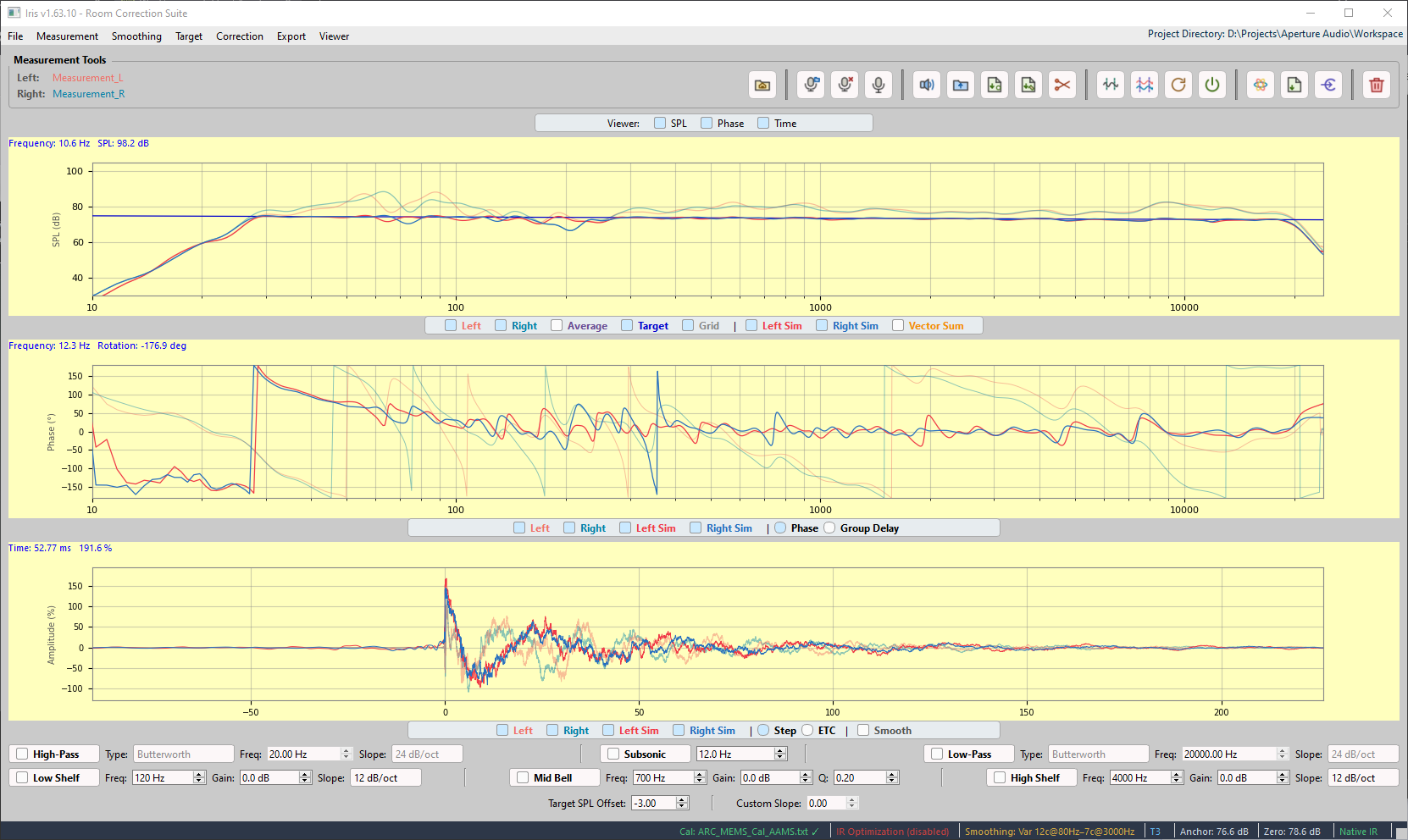
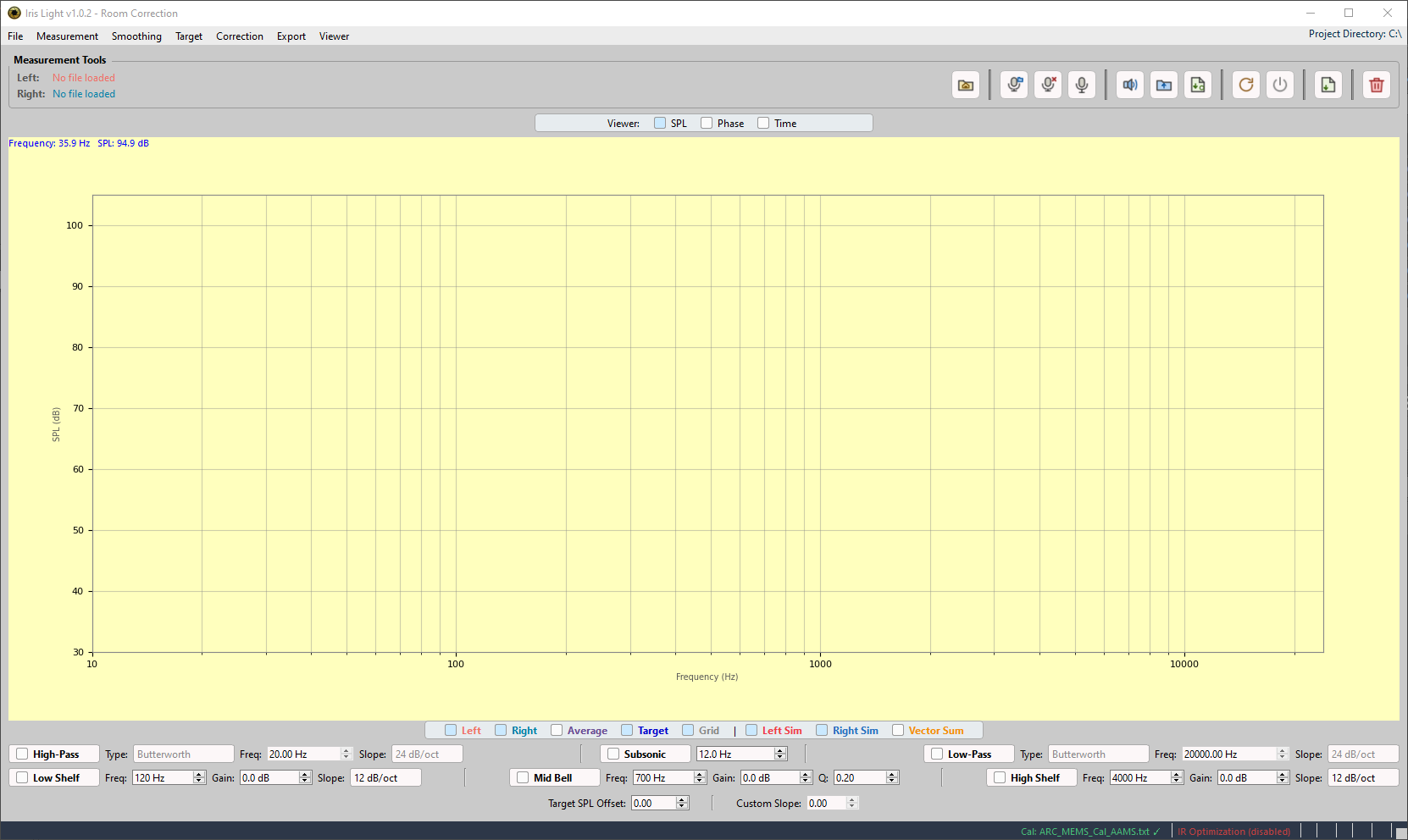
Frequency domain simplicity.
- Permits the user to spend less time configuring filters and focus instead on creating or listening to music
- Corrects only direct frequency magnitudes of the room response, allowing creation of zero-latency filters
- Enhances translation of work across all playback systems by providing a trustworthy sonic foundation
Raw time-domain room correction.
- Regains control of your room's acoustic response by optimizing inter-channel frequency and phase alignment
- Clarifies transient detail, solidifies bass punch, and refines imaging accuracy for a cohesive sound stage
- Ensures translation of work across all playback systems by providing a pure and true sonic foundation
Coda. Faithful companion.
Iris performs all of its functions in 64-bit double precision math. From measurement to filter export, everything Iris calculates remains pure and pristine. This data flow model is realized end-to-end via Coda, Iris's correction filter processor. Iris generates raw 64-bit correction filter data for Coda to process, keeping the signal chain free of mathematical rounding errors and artifacts. The result is your sound, refined, in its purest form.
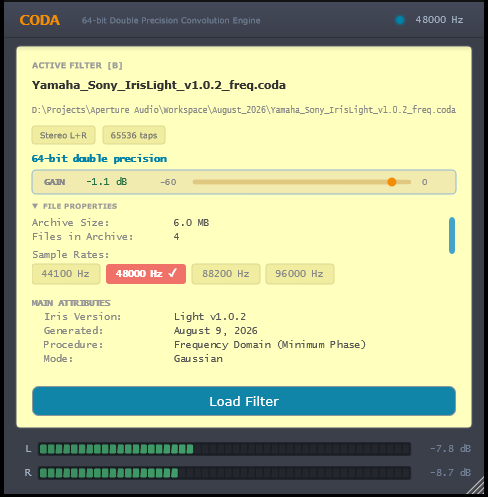
IRIS AND CODA AT A GLANCE
Iris
A powerful suite of tools for room response measurement, room data analysis, and correction filter design.
Room Measurement
Let Iris be the lens into your acoustic space, offering SPL calibration and room measurement in a compact solution. Iris also features a robust microphone alignment utility.
Room Data Analysis
Three independent graphs plot your room's measurement data across frequency and time domains. Analyze what matters, from magnitude relationships to phase coherence.
Filter Design
Iris offers an elegant set of tools for filter design, including core target shape selection, a five-band target sculpting equalizer, and specialized time-domain tuning optimizations.
Filter Export
When your correction filter has been designed, Iris can export it for 64-bit processing in Coda. Iris also supports standard 32-bit wav+cfg exports in zip format for HLConvoler.
Coda
Advanced convolution processor built in conjunction with Iris to provide true end-to-end 64-bit processing.
Raw Double Precision Engine
Coda reads correction filter data directly from Iris. The primary engine crunches all of the numbers within 64-bit float arrays, leaving no rounding errors or other artifacts behind.
Multi-format Architecture
Coda offers support for multiple formats, including its own proprietary 64-bit .coda files and traditional 32-bit zip (.wav+cfg) files. Also in development is the new experimental Halo multi-phase array filter.
Focused Workflow
Featuring minimal controls, Coda evades the trap of creating too many options for the sound it outputs. Available controls are merely manual and automatic gain compensation and three separate filter banks. The sound speaks for itself. No bells or whistles necessary.
Common Questions
How do I integrate Iris correction with my DAW?
Iris generates correction filters that are processed either with Coda or a 3rd-party convolver. Each of these options is available in VST3 and AU formats for use in all major DAWs. Correction filters are always placed at the end of the signal chain, at the end of the very last bus in the mixer. To keep the filtered sound out of your final renders or bounces, the correction plugin must be disabled prior to DAW export. Alternatively, the correction plugin may be placed on a monitor or listen bus (if one is available in your DAW) to keep the filtered sound you hear away from your active mixer exports.
What is the difference between frequency domain and time domain correction?
Basically, the differences between the two are definable in terms of a trade-off between quality and latency.
Frequency domain correction focuses entirely on the magnitude response strength (SPL) measured by each loudspeaker at the listening position, and knowingly ignores the room's phase distortion in the calculations. Only the phase response of the direct sound is considered. This process allows the filter to act only on direct frequency data from the speakers while leaving the room's phase distortions untouched; a condition which leaves the arrival of frequencies in time to the discretion of the room. Thus, it avoids latency at the expense of correction quality. This type of filter is often referred to as "minimum phase". It is a basic filter type that is typically most effective for live tracking scenarios or watching movies, where the quality of the correction is ultimately less important than synchronization of the audio stream with real-time playback of other sources.
Time domain correction runs the full gamut in its calculations without compromise. The room's phase distortions are corrected in accordance with its frequency magnitudes, which adds varying amounts of latency in order to align the time-arrival (time-coherence) of all frequencies at the listening position. This advanced filter type offers superior accuracy of details and clarity of soundstage for listening-focused tasks in which synchronization with other playback sources is secondary.
Are Iris's audio processing algorithms built for real-time use?
Yes. Iris generates FIR (finite impulse response) correction filters for use in external processors, such as Coda and other convolution engines. All Iris room correction filters are designed for real-time performance with varying degrees of latency, depending on the filter type. To ensure coherence to latency requirements, it is advisable to use the format tailored to your specific needs:
- Zero latency = minimum phase frequency domain correction: "freq" procedure type.
- Medium latency = raw time domain (RTD) correction: "T" type.
- Maximum latency = raw time domain (RTD) correction: "N" type.
Can Iris's .coda format be used by any other processor?
No. The .coda filter is a proprietary 64-bit floating point format that can only be processed by Coda. If you want to use Iris correction in another processor, export your filter in the 32-bit wav+cfg zip format.
Can correction filters be processed simultaneously in parallel?
Typically, no. There are exceptions, however. Coda, like every other convolver, only processes the output of one filter at a time. Generally speaking, only one instance of your convolution processor should be handling the audio at a time throughout the entire signal path. Two should never be used in series. However, if two would be used in parallel, the scenario would be one in which the first instance contains the filter for a pair of main loudspeakers and the second instance contains the filter for a subwoofer, or a stereo pair of subwoofers. In that scenario, an audio interface with multiple output routing is required to send the mains' filter to the mains and the subwoofer filter to the subwoofer (or subwoofers).