
CADENCE
MASTER YOUR HEADPHONES
Software that hears you.
Offering a unique solution for critical listening applications in headphones, Cadence features unit-specific headphone calibration and a three-stage hearing profiler consisting of an objective hearing threshold test to calibrate the ears, a spectral balance check to ensure amplitude cohesion, and a stereo image centering check to ensure that all frequencies are equally distributed between the ears. No two people hear frequencies the same way. Cadence listens to you, individually, and delivers exactly what you need to experience your music the way it was meant to be.
Truly personal.
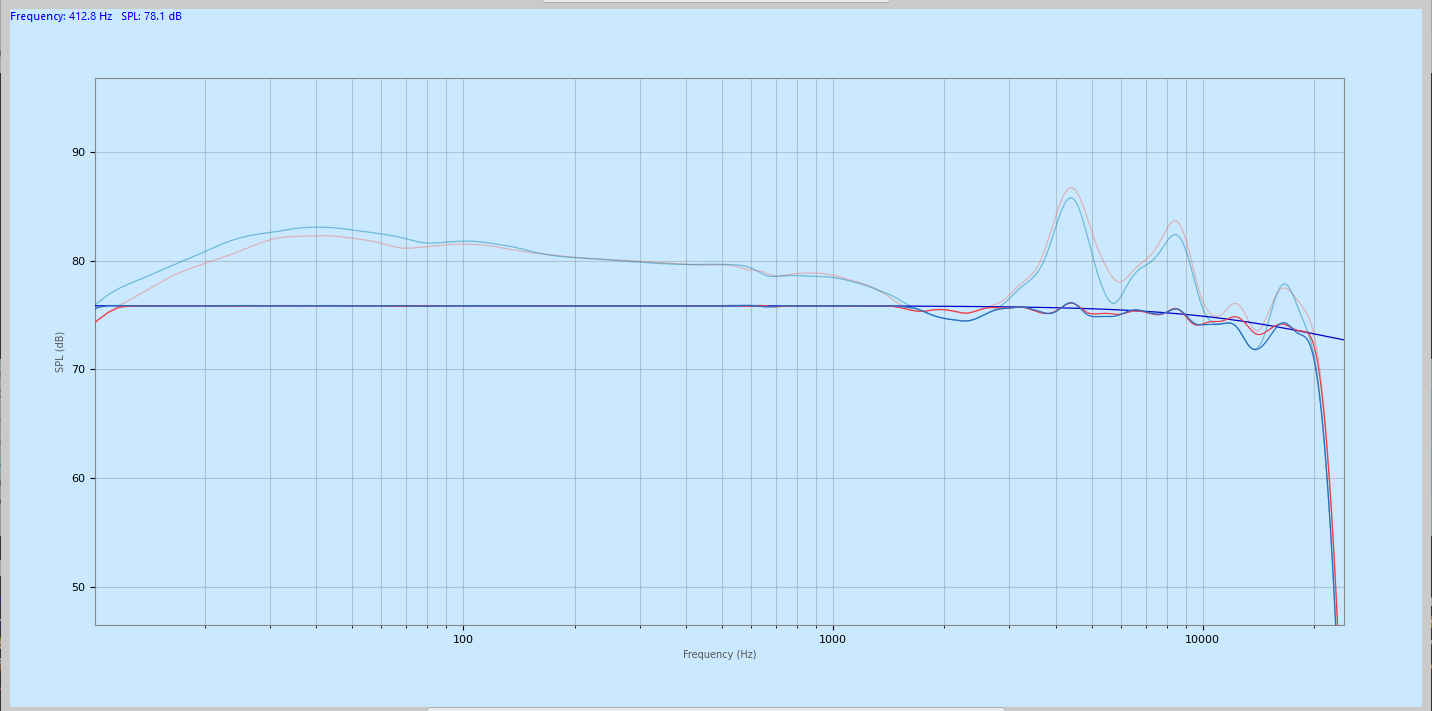
Cadence wields two completely independent sets of data, compiling them together on the fly as you listen. The headphone calibration filter is the first stage, linearizing the response of the hardware and providing the clean foundation for the hearing profile that comes after it. Cadence rebuilds the correction filter each time a listening test is committed, allowing you to refine the accuracy of your correction based on the number of tests you complete.
Cadence compiles its correction in real time 64-bit double precision, summing the cumulative effect of the headphone unit calibration and your hearing profile into a single cohesive and phase-accurate filter. The result is a crystal-clear presentation of the sound that is pure and true to the music, second to none in quality, and personalized for you.
All-in-one Solution
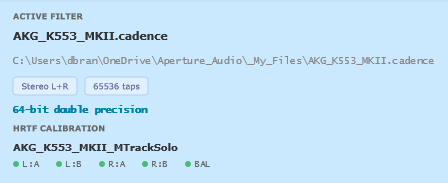
Correction in the truest sense, Cadence sums all headphone and hearing calibration stages into one cohesive 64-bit filter, avoiding potential phase anomalies and other distortion.
Headphone Correction
Cadence supports individual unit correction as well as third-party calibration files. Send in your headphones for calibration, or send existing files for conversion.
Hearing Calibration
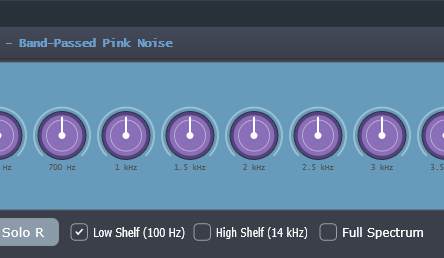
Cadence features an advanced hearing profiler that tunes the corrected response of the headphone to your own ears, allowing the sound to be truly and accurately personalized.

Correction Strength
The strength control lets you dial some of the raw response tone back into the corrected sound to taste. You can even reposition where the strength control sits in the signal path.
Common Questions
Does Cadence compensate for hearing loss?
Yes, but not in a medical capacity. It is not designed as a medical analysis tool. Cadence merely sculpts the sound based on your ability to hear test tones in each ear across critical regions of the spectrum to align your hearing with an accurate music listening experience .
Do I need to go through all of the hearing tests before I can use Cadence?
No. As a matter of fact, you are not required to use the hearing profiler at all. Sometimes the headphone calibration file is all that's needed to provide a satisfactory result. However, hardware calibration alone does not take into account all of the variations our individual ear anatomy imposes on the perception of the sound. Therefore, to get the most out of Cadence, it is recommended to at least work through Test A and commit it to the filter. The more tests you do, the more reassurance you'll get that the headphone response is accurate.
Why does Cadence lower the output volume level of my music?
It is perfectly normal to experience several decibels of volume loss while monitoring through Cadence. The answer to this question lies in one fundamental rule, enforced to protect your equipment: at no point in the filter's output path is it allowed to introduce its own clipping by boosting signal levels beyond digital limits. Cadence, by design, cannot force the playback signal to exceed digital zero. It can only attenuate to balance the sound. If your headphone calibration and/or hearing profile cause the loudest point in the filter data to lie at or above 0 dB full scale, the entire filter must be normalized to -0.1 dB, which is safe just below the ceiling. Attenuation translates to volume loss. Compensate for this phenomenon by raising the output volume of your headphone DAC.
Can Cadence be used to create a hearing profile for me in a room?
No. Cadence uses psychoacoustic profiling to contour the sonic signature of your headphones to your hearing. Among other complications, this target does not translate to acoustic spaces outside of the headphone cups.